
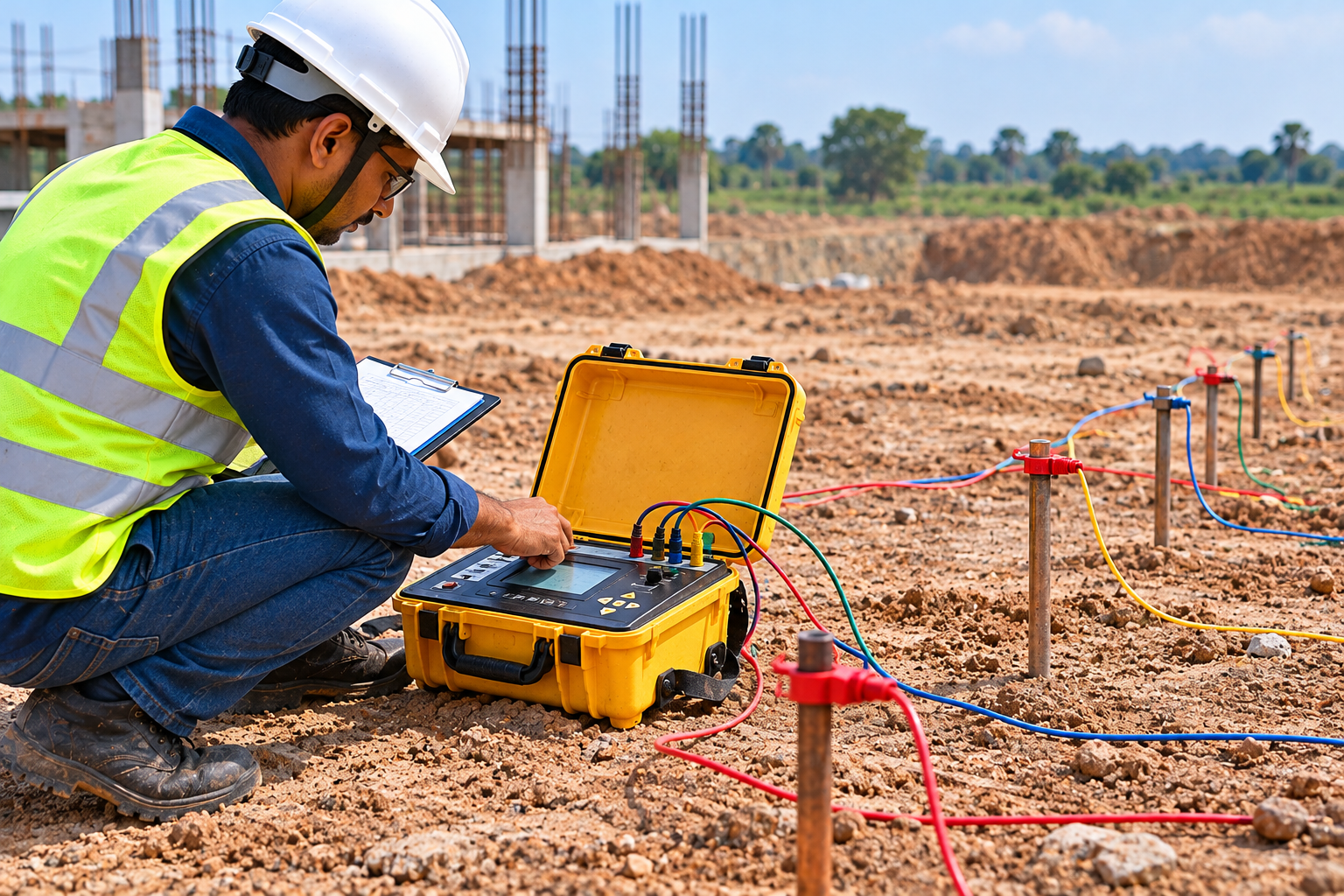
Earth Resistivity Testing
Earth resistivity testing is an important site investigation service used to evaluate the electrical resistivity of soil. At OM Test House, earth resistivity testing supports engineering investigations for earthing systems, electrical installations, substations, industrial facilities and other infrastructure projects.
Soil resistivity influences how electrical current travels through the ground. Understanding its variation across a site helps electrical engineers assess grounding requirements and plan suitable earthing arrangements. The results depend on soil composition, moisture content, temperature, compaction and the geological conditions of the location.
What Is Earth Resistivity Testing?
Earth resistivity testing measures the resistance of soil to the flow of electrical current and expresses the result as electrical resistivity, commonly in ohm-metres (Ω·m). The measurements provide information about the electrical characteristics of the ground at different locations and investigation depths.
These measurements are useful during the planning and design of grounding systems. They can help engineers understand variations in soil conditions and evaluate the suitability of a proposed site for electrical earthing applications.
Soil Resistivity Measurement
Soil resistivity measurements are generally performed using suitable electrodes placed in the ground and a dedicated earth resistivity tester. A commonly used approach is the four-electrode Wenner method, in which electrode spacing is varied to obtain information about apparent soil resistivity under different measurement configurations.
The measurement arrangement, electrode spacing and test locations should be selected according to the site conditions, investigation objectives and applicable technical procedures. Field readings should be interpreted with an understanding of the method's assumptions and limitations.
Importance of Earth Resistivity Testing
Soil resistivity is a key input for evaluating grounding and earthing system designs. Accurate site measurements can help engineers assess ground conditions, identify changes in resistivity and make informed decisions during electrical infrastructure planning.
Since soil conditions can vary significantly across a site, measurements at multiple locations or electrode spacings may be required. A single reading may not adequately represent the entire site.
Applications of Earth Resistivity Testing
- Electrical Substations: Soil resistivity data can support the design and evaluation of substation grounding systems.
- Industrial Facilities: Testing helps engineers assess soil conditions for earthing arrangements at factories, plants and industrial sites.
- Commercial and Residential Projects: Resistivity measurements can provide supporting information for electrical earthing system design.
- Power Infrastructure: Soil resistivity data may be required for selected power distribution and transmission-related projects.
- Telecommunication Installations: Testing can support grounding design for communication facilities and equipment installations.
- Solar Power Projects: Soil resistivity measurements can help inform earthing arrangements for solar plants and associated electrical infrastructure.
- Lightning Protection Systems: Soil resistivity data can be used as an input when planning suitable grounding arrangements.
Factors Affecting Soil Resistivity
Several natural and site-related factors influence the electrical resistivity of soil. Understanding these factors is important when planning measurements and interpreting the test results.
- Soil Type: Clay, sand, gravel, rock and mixed soil formations may exhibit different electrical resistivity values.
- Moisture Content: Changes in soil moisture can significantly influence electrical conductivity.
- Temperature: Soil temperature can affect the electrical properties of the ground.
- Mineral and Salt Content: Dissolved salts and mineral composition can influence the movement of electrical current through soil.
- Soil Layers: Variations in subsurface materials can cause resistivity to change with depth.
Earth Resistivity Testing Procedure
The process begins with reviewing the site location, project requirements and intended application of the measurements. Suitable testing points are identified, and the selected electrode arrangement is installed according to the applicable procedure.
Measurements are recorded at the required locations and electrode spacings. The readings are reviewed for consistency, and apparent resistivity is calculated using the appropriate method. The results are then documented for technical evaluation and engineering use.
Benefits of Earth Resistivity Testing
- Provides information about the electrical characteristics of soil.
- Supports the planning and design of grounding and earthing systems.
- Helps identify variations in soil resistivity across a site.
- Supports electrical infrastructure investigations and project planning.
- Provides field data for engineering assessment and technical documentation.
- Helps engineers consider site-specific ground conditions in earthing design.
Testing Standards and Technical Reporting
Earth resistivity measurements should follow the applicable testing procedure and relevant electrical engineering standards for the project. The selected method, electrode spacing, test locations and site conditions should be documented so that the results can be interpreted appropriately.
Test reports may include the measurement locations, electrode arrangement, recorded readings, calculated resistivity values and relevant observations within the agreed scope of work.
Who Can Benefit from Our Services?
Earth resistivity testing may be useful for electrical consultants, civil engineers, EPC contractors, power infrastructure developers, industrial project owners, solar project developers and organizations planning earthing or grounding systems.
Why Choose OM Test House?
OM Test House focuses on project-specific testing requirements, systematic recording of field measurements and clear technical documentation. A suitable testing scope helps clients obtain information about ground conditions for their engineering investigations and planning activities.
- Testing scope based on site and project requirements.
- Systematic documentation of field measurements.
- Focus on soil resistivity evaluation and technical reporting.
- Support for electrical and infrastructure project investigations.
- Technical coordination within the agreed scope of services.
Contact OM Test House
If you require earth resistivity testing for a substation, industrial facility, solar project, commercial development or other infrastructure site, contact OM Test House. Share your site location, project details and testing requirements so that the appropriate investigation scope can be discussed.